
Why AI Airline Pricing Will Change the Way You Book Flights (And Save Money)
- Refare Team
- Feb 12
- 5 min read
Quick Answer
AI airline pricing uses machine learning to adjust flight fares in real-time based on thousands of variables: from competitor pricing to weather forecasts to individual browsing behavior.
Unlike traditional dynamic pricing that follows pre-set rules, AI processes millions of pricing scenarios in milliseconds, enabling airlines to personalize fares for different customers. The challenge? This sophisticated pricing works in the airline's favor unless you have your own AI watching prices after you book. That's where services like Refare come in, using AI to monitor your flights and automatically secure refunds when prices drop.
TL;DR
Airlines are using AI to optimize every ticket price based on massive amounts of data and individual customer profiles. This means fares can change hundreds of times before your flight, and you might pay more than the person sitting next to you.
The good news? AI-powered tools like Refare now monitor prices after you book and automatically get you refunds when fares drop, turning the tables on airline pricing algorithms. It's the shift from manual price hunting to AI-managed savings.
The days of simple airline pricing are over. Behind every flight search you run, sophisticated AI algorithms are working at lightning speed to determine exactly how much you should pay. And here's the thing: they're getting smarter every day.
But this isn't a story about airlines gaining more power. It's about how AI is fundamentally changing the travel landscape for everyone, including you. Because while airlines use AI to maximize revenue, travelers can now use AI to maximize savings. Welcome to the future of flight booking.
How AI is Revolutionizing Airline Pricing
Remember when airline pricing was relatively straightforward? Book early, save money. Wait too long, pay more. Those days are ancient history.
Today's airline pricing systems are powered by machine learning algorithms that make traditional dynamic pricing look like a calculator compared to a supercomputer. Modern AI can process millions of pricing scenarios in milliseconds, factoring in thousands of variables simultaneously.
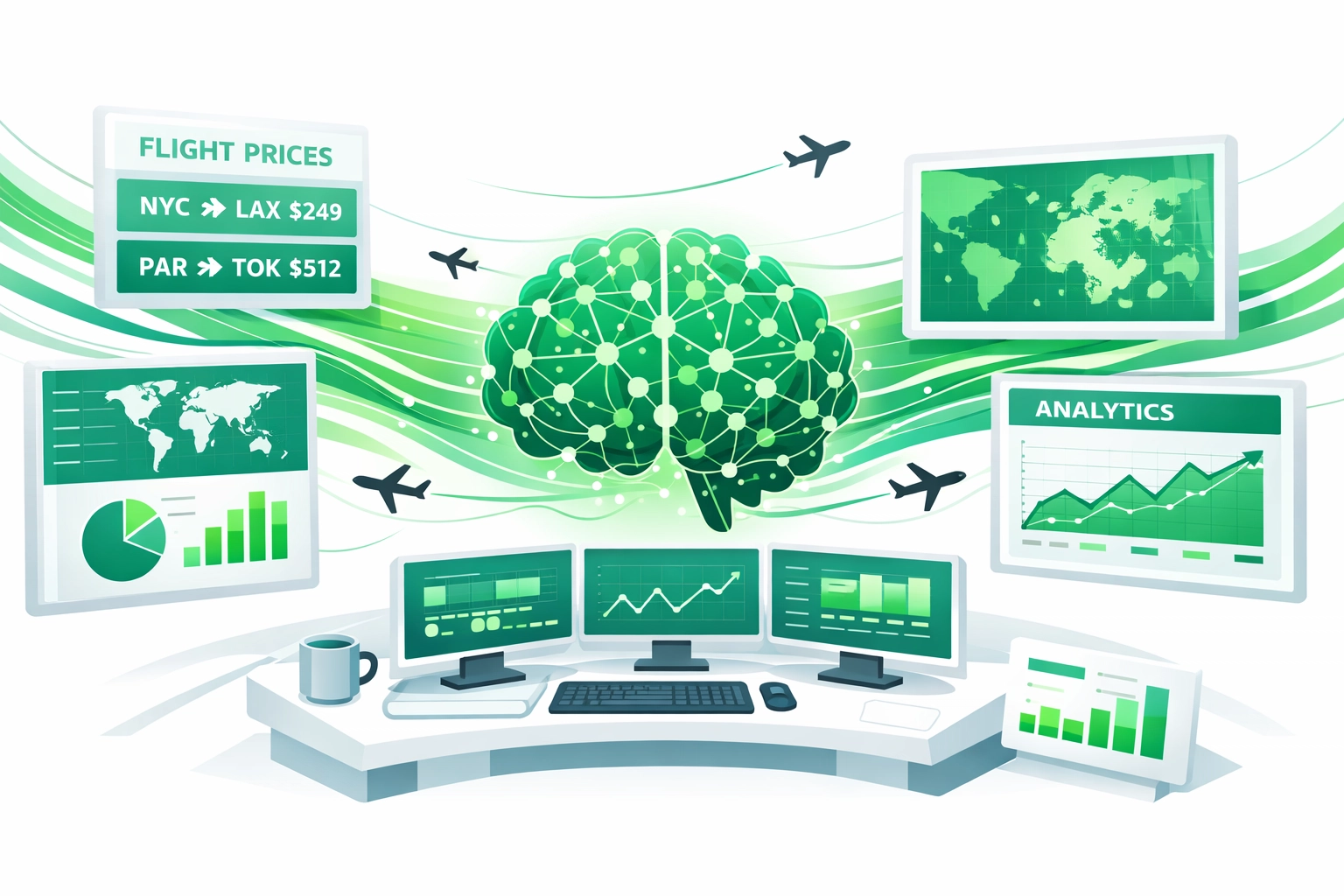
What kinds of variables? Everything you can imagine and plenty you can't:
Competitor pricing across hundreds of routes
Weather forecasts that might impact demand
Local events in departure and arrival cities
Social media sentiment about destinations
Historical booking patterns for similar routes
Seat availability across the entire network
Even your individual browsing and booking history
Unlike traditional systems that follow pre-programmed rules, AI generates pricing strategies by understanding market dynamics at a fundamental level. It's like having a superpowered revenue analyst that never sleeps, never takes breaks, and makes both bold and conservative pricing decisions based on confidence levels.
The result? Flight prices can change hundreds of times before departure, and the fare you see might be tailored specifically to you based on factors you don't even realize the airline is tracking.
The Real-Time Optimization Game
Here's where it gets really interesting. When multiple market disruptions happen at once: a competitor drops prices, weather threatens flights, and a major sporting event gets rescheduled: traditional pricing systems struggle to adjust. They might handle one scenario at a time, but multiple simultaneous changes? That's where they fall apart.
AI-driven systems handle this effortlessly. They adjust prices across the entire network instantly, making thousands of micro-decisions that optimize revenue while staying competitive. It's real-time precision at a scale that was impossible just a few years ago.
For airlines, this is revolutionary. For travelers? It used to feel like playing a game where you didn't know the rules and the goalposts kept moving.
The Power Shift: From Airlines to You
Here's the exciting part: AI doesn't just benefit airlines anymore.
The same technology that airlines use to optimize pricing can now work for you. Services like Refare flip the script entirely, using AI to continuously monitor flight prices after you book. When the airline's AI drops your fare (which happens more often than you'd think), Refare's AI catches it and automatically secures your refund.
Think about that for a moment. You're no longer stuck hoping you booked at the right time or manually checking if prices dropped. You've got your own AI working 24/7 to make sure you always get the best price, even after you click "purchase."
This represents a fundamental shift in how travel is consumed. You're moving from:
Manual searching → AI-managed savingsOne-time booking → Continuous optimizationHoping for luck → Guaranteed best price
How Refare Levels the Playing Field
Airlines use sophisticated algorithms to maximize revenue. Refare uses sophisticated algorithms to maximize your savings. It's that simple.
Here's how it works in practice:
You book your flight through any airline or travel site
Forward your confirmation to Refare (takes about 30 seconds)
AI monitoring begins instantly, tracking your specific flight's price changes
When prices drop, Refare automatically negotiates with the airline
Refunds go directly to your original payment method or frequent flyer account

No manual price checking. No screenshot collecting. No spending hours on hold. Just submit your booking and let AI do what it does best: process massive amounts of data to find savings opportunities you'd never spot manually.
The average savings? $218 per eligible itinerary in 2025, with a 98% success rate when price drops occur. Some travelers saved over $400 on a single flight.
What This Means for Your Travel Budget
Let's talk about the practical impact on your wallet. Airfare is typically one of the biggest travel expenses, and AI pricing means those costs are more volatile than ever. But volatility works both ways.
When airlines adjust prices downward to fill seats or respond to competition, you can benefit automatically. No more kicking yourself for booking too early or wondering if you should have waited. Your AI is always watching.
This is especially powerful for frequent travelers. Book your flights as soon as your plans are set, then let continuous monitoring ensure you're always getting the best available price. You maintain your preferred seat assignments, keep your miles and status credits, and still capture savings when prices drop. That's the "Loyalty Double-Dip" advantage.
Consider this: If you take six flights per year and save an average of $200 per flight through automated monitoring, that's $1,200 back in your pocket annually. For frequent business travelers taking 20+ flights? The savings compound significantly.
The Future of Smart Travel
We're at the beginning of a major transformation in how people approach travel planning and budgeting. The old model: spend hours researching, book at the "right" time, hope for the best: is giving way to something far more efficient.
AI-managed travel means you focus on where you want to go and what you want to do, while algorithms handle the financial optimization. It's not about removing the human element from travel. It's about removing the tedious, time-consuming, and often frustrating parts.
Think of it like investing. You wouldn't manually track every stock price and execute trades yourself when automated portfolio management exists. Similarly, you shouldn't manually track flight prices when AI can do it better, faster, and more reliably.
The airlines already made this shift years ago. Now it's your turn to benefit from the same technological advantages.
Bottom Line
AI has fundamentally changed airline pricing, creating a dynamic system where fares adjust constantly based on massive amounts of data. Airlines use this technology to maximize revenue, but travelers can now use AI-powered tools like Refare to maximize savings. Instead of manual price monitoring and hoping you booked at the right time, you can let AI continuously watch your flights and automatically secure refunds when prices drop. It's the shift from reactive booking to proactive savings management: and it puts you on equal footing with airline pricing algorithms. The future of travel isn't about working harder to find deals; it's about working smarter by letting AI manage the optimization for you.
Ready to stop playing the airline pricing game and start winning it? Check out how Refare works and join thousands of travelers who've already made the switch to AI-managed savings. Your wallet will thank you.
Happy travels! ✈️
